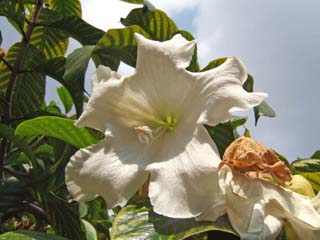
BEAUMONTIA
Contributed by K.W. Woo
The common names for these large woody climbers are Beaumontia and “Herald's Trumpet”. The origin of B. grandiflora is in the Himalayas and Northern India. B. murtonii is the finest among the Beaumontias grown and its origin is Thailand. The one which flowers most freely is B. multiflora. B. jordonia is only successful in places where the dry season is well-defined.
The description below refers to B. grandiflora.
It is the largest and most vigorous climber of the Beaumontias. It has large cup-shaped, white waxy flowers at the end of young shoots. It is quite free flowering from December to March, and intermittently at other times. The flowers are slightly lily-scented. It repays good cultivation.
The morning sun day suits it best. The plant will be well-placed if it is facing east. If too much shade is given the shoots will not be matured enough to produce flowers. After flowering the plant should be pruned to encourage most shoots later. Follow the pruning by giving the plant a top dressing of manure and bonemeal.
Layering of young matured shoot is the best and most reliable method to propagate Beaumontia. It can also be propagated from woody cuttings. Seeds are rarely produced. Cutting is difficult to strike and it takes 4 years to bloom. Sometimes root suckers are found at the base of the stem and these should be carefully removed and inserted into moist sand. Plant out when well-established.
The flowers can be used for table decoration. The flowers should be picked when they are just opening. The plant is excellent for growing on arches and over pergolas. Both should be built strongly to withstand the weight of the climber.